

How Does Tai Chi Work for Diabetes?
Dr Paul Lam
Exercise helps people with diabetes by improving the control of blood glucose level, also by minimising the complications of diabetes. Tai Chi will help improve cellular uptakes and glucose metabolism. There are other advantages of doing Tai Chi, it is proven to have high adherence, it is enjoyable and benefit many other aspects of health. Tai Chi for Diabetes is a specially created program by Dr Lam for people with diabetes.
How Does Tai Chi Work For Diabetes?
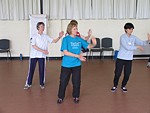 Diet
and exercise are the cornerstone of diabetes management. People with diabetes
who exercise regularly have better control over their blood glucose levels and
fewer complications such as heart disease and stroke.
Diet
and exercise are the cornerstone of diabetes management. People with diabetes
who exercise regularly have better control over their blood glucose levels and
fewer complications such as heart disease and stroke.
Many people, however, are unable to keep up with their regular exercise because they either don’t enjoy it, or have a problem finding time to exercise. Tai chi offers a major advantage: It’s enjoyable, and to many, it’s almost addictive. After getting over the initial learning phase (about three to six months) and becoming familiar with the rhythm and feel of tai chi, most people continue exercising. You can practice Tai Chi almost anywhere.
Gentle exercise has been shown by studies to prevent diabetes in 60 percent of cases (reference 1, reference 2). Therefore, since tai chi is a gentle exercise, we can assume that it’s effective in preventing and improving the control of diabetes.
Stress stands in the way
of controlling diabetes. Since tai chi encourages mental relaxation and reduces
stress, it follows that Tai Chi can improve the control of diabetes.
The major problems of diabetes are the associating complications such as heart
disease, visual impairment, and stroke. Tai chi focuses on building strength,
balance and flexibility through slow, fluid movements combined with mental imagery
and deep breathing. Scientific studies have shown tai chi to have beneficial
effects on cardio-respiratory fitness, muscular strength, balance, peripheral
circulation, reduced tension, and anxiety.(reference 3,reference
4, reference 5, reference 6, reference
7, reference 8). These in turn minimise the complications
of diabetes.
Diabetes causes peripheral neuropathy, a condition in which the nerves in the feet are damaged thus affecting stability in walking. Tai chi has proved to be effective in helping balance and mobility.
The Power of the Mind
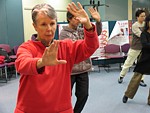 Tai
chi enhances concentration, clarity of the mind, improves relaxation and uplifts
the mood. The immense power of the mind has not been fully estimated. As one
of the most effective mind-body exercises, tai chi helps the student to be aware
of the intrinsic energy from which he or she can perceive greater self-control
and empowerment.
Tai
chi enhances concentration, clarity of the mind, improves relaxation and uplifts
the mood. The immense power of the mind has not been fully estimated. As one
of the most effective mind-body exercises, tai chi helps the student to be aware
of the intrinsic energy from which he or she can perceive greater self-control
and empowerment.
Chinese Traditional Medicine and the Power of Qi
Qi is the life energy inside a person. The concept of qi is fundamental in most eastern cultures. In fact, Chinese traditional medicine is based on this concept. Designed to cultivate and enhance qi, tai chi encourages gentle and slow movements which stretch one’s meridians (energy channels along which qi travels) and keeps them strong and supple. The rhythmic movement of the muscle and joints pump energy through the whole body.
According to traditional Chinese medicine, diabetes is a deficiency of moisture and essence (yin) of the lung, spleen and kidney meridians . Enhancing qi in the appropriate meridians (reference 9) will therefore improve diabetes.
Tai Chi for Diabetes
– A specially designed program supported by Diabetes Australia
Step-by-step instructional video/DVD Duration 90 mins
Designed to help prevent and improve control of diabetes by gently increasing physical activities, cellular uptake of glucose and relaxation. It enhances Qi (life energy), which according to traditional Chinese medicine will help control diabetes. This program can be used for general fitness and health.
The program includes a general introduction of Tai Chi and diabetes, warm up and cooling down exercises, Qigong for Diabetes, 11 basic movements and 8 advanced movements. Viewers can learn different part at their own pace using the easy-to-learn and step-by-step instructions.
You can purchase your copy of this DVD/video from your local Diabetes Australia’s branches. For more information or order online from this site.
Reference for Diabetes
1. J Tuomilehto & Associates, Department of Epidemiology
and Health Promotion Helsinki, 3 May 2001. Prevention of Type 2 Diabetes Mellitus
by Changes in Lifestyle Among Subjects With Impaired Glucose Tolerance. The
New England Journal of Medicine.
2. The New England Journal of Medicine, VOLUME 346, FEBRUARY
7, 2002, NUMBER 6. Eeduction In The Incidence Of Type 2 Diabetes With Lifestyle
Intervention Or Metformin.
3. Lai J, Lan C, Wong M and Teng S. 1995. Two-Year Trends in
Cardiorespiratory Function Among Tai Chi Chuan Practitioners and Sedentary Subjects.
Journal of American Geriatrics Society, 43(11), p 1222-1227.
4. Wolfson L, Whipple R, Cerby C, Judge J, King M, Amerman P,
Schmidt J and Smyers D. 1996. Balance and Strength Training in Older Adults:
Intervention Gains and Tai Chi Maintenance. Journal of American Geriatric Society,
44(5), p 498-506.
5. Lan C, Lai J, Chen S and Wong M. 2000. Tai Chi Chuan to Improve
Muscular Strength and Endurance in Elderly Individuals: a Pilot Study. Archives
of Physical Medicine & Rehabilitation, 81(5), 604-607.
6. Hong Y, Li X and Robinson P. 2000. Balance Control, Flexibility,
and Cardiorespiratory Fitness Among Older Tai Chi Practitioners. British Journal
of Sport Medicine, 34(1), p 29-34.
7. Wang J, Lan C and Wong M. 2001. Tai Chi Chuan Training to
Enhance Microcirculatory Function in Healthy Elderly Men. Archives of Physical
Medicine & Rehabilitation, 82(9), p 1176-1180.
8. Brown D, Wang Y, Ebbeling C, Fortlage L, Puleo E, Benson
H and Rippe J. 1995. Chronic Psychological Effects of Exercise and Exercise
Plus Cognitive Strategies. Medicice & Science in Sports and Exercise, 27(5),
p 765-775.
9. Chinese Medical Theories, Between Heaven and Earth by Harriet
Beinfield and Efrem Korngold